Sensex vs Nifty 50: What is the Difference and Which One Should You Track?
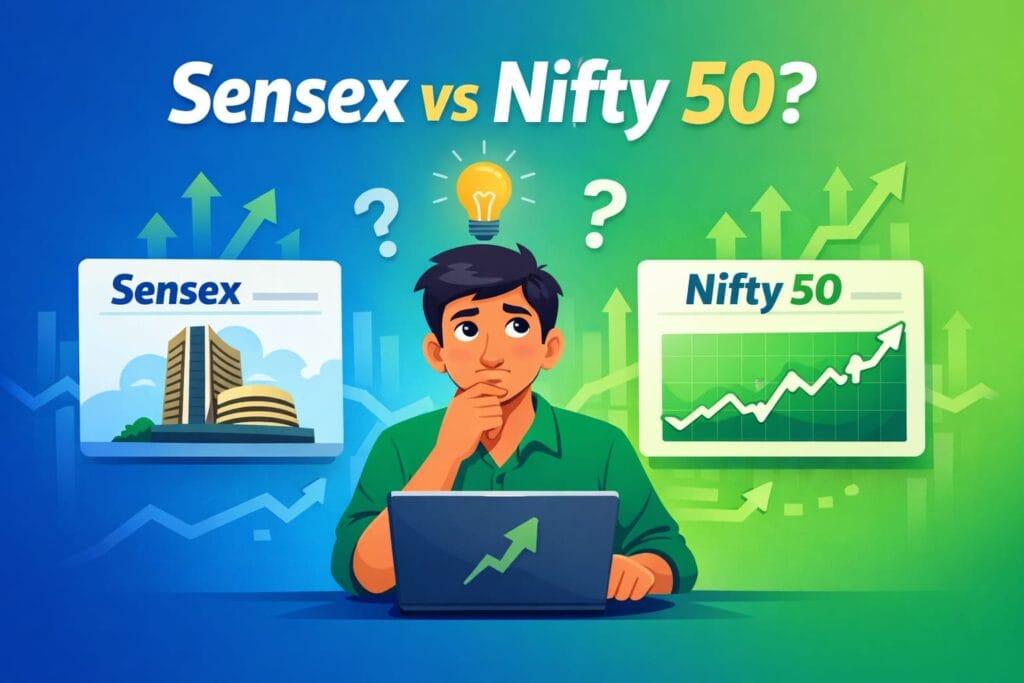
Table of Contents
Every morning, you open a news app or switch on the TV and someone says “Sensex drops 500 points” or “Nifty hits all-time high.” And if you’re new to investing, your brain immediately asks: Wait are these two different things? Are they both the stock market? Which one should I actually be looking at? You’re not alone. This is one of the most common confusions among beginner investors in India. The good news is the answer is simpler than you think. By the end of this article, you’ll know exactly what Sensex and Nifty 50 are, how they differ, and most importantly which one you should track as an investor.
What is Sensex?
Sensex is short for Sensitive Index. It is the benchmark index of the Bombay Stock Exchange (BSE) — India’s oldest stock exchange, founded way back in 1875. Sensex was launched in 1986, making it the oldest stock market index in India. It tracks the performance of 30 of India’s largest and most established companies listed on the BSE — companies like Reliance Industries, HDFC Bank, TCS, Infosys, ITC, and Maruti Suzuki. Think of Sensex as a report card for India’s 30 biggest blue-chip companies. When these 30 companies are doing well overall, Sensex goes up. When they struggle, it goes down.
Key facts about Sensex:
- Exchange: BSE (Bombay Stock Exchange)
- Number of companies: 30
- Launched: 1986
- Base year: 1978–79
- Base value: 100
What is Nifty 50?
Nifty 50 is short for National Stock Exchange Fifty. It is the benchmark index of the National Stock Exchange (NSE) — India’s larger and more modern exchange by trading volume. Nifty 50 was launched in 1996 and tracks the performance of 50 of India’s top companies across 24 different sectors. It includes all the major Sensex companies plus 20 more — giving you a broader, more representative picture of the Indian economy.
Nifty 50 was launched in 1996 and tracks the performance of 50 of India’s top companies across 24 different sectors. It includes all the major Sensex companies plus 20 more — giving you a broader, more representative picture of the Indian economy. Think of Nifty 50 as a slightly bigger, more modern report card — covering 50 companies across more industries.
Key facts about Nifty 50:
- Exchange: NSE (National Stock Exchange)
- Number of companies: 50
- Launched: 1996
- Base year: November 1995
- Base value: 1,000
Sensex vs Nifty 50: The Key Differences
Here’s a clean comparison so you can see both side by side:
| Feature | Sensex | Nifty 50 |
|---|---|---|
| Full name | Sensitive Index | National Stock Exchange Fifty |
| Exchange | BSE | NSE |
| Companies tracked | 30 | 50 |
| Sectors covered | 13 | 24 |
| Launched | 1986 | 1996 |
| Base value | 100 | 1,000 |
| Market cap coverage | ~45% of total | ~65% of total |
| Derivatives trading | Less active | Very active (F&O) |
Do They Move Together or Differently?
This is the question most beginners ask and the answer will surprise you. They move almost identically, almost all the time. Since both indices track the same large Indian companies (there is significant overlap — most Sensex companies are also in Nifty 50), they rise and fall together in almost every market situation. On a day when Sensex drops 1%, Nifty 50 will almost certainly also drop around 1%. Over the long term, the difference in returns between the two is typically 0.1% to 0.5% annually — barely noticeable for a regular investor. So if you’re watching the news and they say “Sensex fell 800 points today” — know that the Nifty 50 almost certainly fell by a proportionally similar percentage.
Why Do Both Exist Then?
They exist for historical and institutional reasons:
Sensex is the older index and has been India’s market barometer since the pre-liberalisation era. It’s deeply embedded in Indian financial culture and media. When your parents or grandparents talk about the “share market going up,” they’re thinking about Sensex. Nifty 50 came later but quickly became the preferred index for traders, institutional investors, and financial products. Today, Nifty 50 is used as the underlying for most futures and options (F&O) trading in India, making it more relevant for active market participants.
Sensex vs Nifty 50 – Which One Should You Track as a Beginner?
Here’s the straight answer: track Nifty 50. I myself tracked nifty 50 when I was new to the stock market. I followed every company in nifty 50 which covers all sectors of the stock market. These companies are often called as blue chip companies.
Three practical reasons:
1. It’s broader. Nifty 50 covers 50 companies across 24 sectors — giving you a more complete picture of how the Indian economy is performing, not just how 30 companies are doing.
2. Most investment products are linked to Nifty 50. When you invest in an index fund or ETF — which is the recommended starting point for beginners — you’ll likely be investing in a Nifty 50 index fund. Products like UTI Nifty 50 Index Fund, HDFC Nifty 50 Index Fund, and Nippon Nifty 50 BeES are all Nifty 50 products. So tracking Nifty 50 directly tells you how your investment is performing.
3. It’s the global standard for Indian equities. Foreign institutional investors, global funds, and international financial media track Nifty 50 when assessing India’s market. It’s the number that matters most in professional investing circles.
That said , keep an eye on Sensex too, since it’s what most Indian news channels lead with. Just know that Nifty 50 is more relevant to your actual investment portfolio.
Can You Invest in Sensex or Nifty 50 Directly?
No you cannot invest in an index directly. An index is just a measurement, like a temperature reading. You can’t buy a temperature. What you can do is invest in index funds or ETFs that mirror the index — buying the same 50 stocks in the same proportion as Nifty 50. This way, when Nifty 50 goes up, your investment goes up by the same amount (minus a tiny expense ratio).
Best Nifty 50 index funds for beginners:
| Fund Name | Expense Ratio | Minimum SIP |
|---|---|---|
| UTI Nifty 50 Index Fund | 0.18% | ₹500 |
| HDFC Index Fund Nifty 50 | 0.20% | ₹500 |
| Nippon India Nifty 50 BeES (ETF) | 0.04% | 1 unit (~₹250) |
| SBI Nifty Index Fund | 0.19% | ₹500 |
Similarly for Sensex:
- HDFC Index Fund Sensex Plan
- SBI ETF Sensex
- Nippon India ETF Sensex
For most beginners, a Nifty 50 index fund SIP starting at ₹500/month is the simplest and most effective starting point.
A Simple Way to Remember the Difference
If you ever get confused again, use this mental shortcut:
Sensex = BSE’s 30 oldest stars Nifty 50 = NSE’s 50 brightest performers
Both are telling you roughly the same story — just from slightly different angles, with Nifty 50 being the broader and more modern perspective.
Sensex and Nifty 50 are not rivals — they’re two windows into the same room. Both show you how India’s biggest companies are doing. Both go up when the economy is growing. Both fall when there’s fear or uncertainty in the market. As a beginner investor in India, watch Nifty 50 as your daily market reference and invest in a Nifty 50 index fund SIP to grow your wealth alongside India’s economy. The market will have good days and bad days. The Sensex will cross 1,00,000. The Nifty will hit 30,000. And the investors who stayed calm, kept their SIPs running, and didn’t panic during dips will be the ones smiling at the end.
You can also know the difference between nifty 50 and Index Fund
FAQs on Sensex vs Nifty 50
Is Sensex or Nifty 50 more important?
Sensex vs Nifty 50 both are important market indicators, but Nifty 50 is more relevant for investors since most index funds, ETFs, and derivatives are based on it. Sensex is more prominent in everyday media coverage.
Which is bigger — BSE or NSE?
NSE is larger by daily trading volume. BSE has more companies listed but NSE processes far more trades each day.
If Sensex is at 80,000 and Nifty is at 24,000, does that mean Sensex is performing better?
No. They have different base values (Sensex started at 100, Nifty at 1,000) so the absolute numbers aren’t comparable. What matters is the percentage change , if Sensex is up 1% and Nifty is up 1%, they’re performing similarly.
Which index should I look at to know if markets are up or down today?
Either one works — they move almost in sync. Just pick one and stick to it. Most Indian investors watch Nifty 50 as their daily reference.
Can a company be in both Sensex and Nifty 50?
Yes. Most of the 30 Sensex companies are also part of Nifty 50. Companies like Reliance, HDFC Bank, TCS, and Infosys appear in both indices.
Disclaimer: The information in this article is for educational purposes only and does not constitute financial advice or investment recommendations. Please consult a SEBI-registered financial advisor before making any investment decisions. Investments are subject to market risks.